SPOILERS
SPOILERS
SPOILERS
After the penultimate episode of Game of Thrones, a fair number of fans were upset with Daenerys's heel turn, after she laid waste to King's Landing.
My initial thought was, "I guess they could have done a little bit more to show her conversion". Perhaps after Rhaegal died they could have spent a minute showing her depression. Perhaps after Missandei's death there could have been a short seen between her and Grey Worm showing her sinking depression. But I didn't think the turn of events was that terrible.
Many fans were far more upset about it, and as I thought about it, I realized that Daenerys's heel turn was far more obvious than I originally thought. And the show did a great job at hiding it.
I want to concentrate on the following.
- Dany sacks Astapor, Yunkai, Meereen (S3 & 4)
- Dany had Drogon burn Kraznys alive (S3E3).
- Dany has the masters crucified (S4E4) (against the suggestion of Selmy).
- Dany feeds masters to her dragons (S5E5).
- Dany tells Tyrion she will lay waste to cities (S6E9) but Tyrion convinces her otherwise.
But the question is why did we not think Dany evil? Despite all of the above, why is she "good"? Why is Cersei "bad"?
Then it finally hits me, and I think it's wonderful storytelling in the end.
The reason is that all of the above are related to slave cities or slave masters. Subconsciously, we don't view mountains of these actions as "evil" or "bad". We subconsciously think of the actions as justified or "ok".
- Kraznys is a slave master and an asshole to boot, so we are happy to see him dead
- Crucifying the masters is A WAR CRIME. She has taken over Meereen, has
taken prisoners, and doesn't elect to imprison them, doesn't elect to
execute them quickly, but specifically chooses to crucify them. But we don't seem that upset because they were slave owners.
- If she wants to burn down cities to the ground, we're sort of ok with that b/c it's slave cities.
- Are all innocents spared in Astapor, Yunkai, and Meereen? I doubt it. We just don't see the sacking of the city, unlike the sacking of Kings Landing.
- Did we forget that Dany decides to go to Astapor in the first place? Apparently she had little qualms of even visiting such a city to inquire about purchasing slaves?
I suppose there's other subtleties as to why we consider Dany "good". The fact that Dany was "poor" and had to bring herself up on her own is part of the tale. The Game of Thrones tale naturally having our hearts and minds view her as "good", and somewhat ignoring mountains of evidence to the contrary. This is in contrast to Cersei, who is trying to maintain her power.
Here's a few other evil things Dany did that I could remember:
- Dany has burns Mirri Maz Duur (S1E10) by her own hand.
- Dany burns khals and others alive by her own hand (S6E4). This includes innocents.
- Dany locked up Xaro Xhoan Daxos and Doreah to die of starvation in a vault (S2E10).
- Dany executes Randyll & Dickon Tarly (S7E5).
How is locking up people in a vault that different than Cersei's imprisoning people in the dungeon? Or how is the burning of the Khals that different than the destruction of the Sept of Baelor? The execution of the Tarlys is again a war crime.
As I thought about the series further, I realized that Dany may have been equally evil to Cersei from the start. However, minor subtleties in the story made her look like "good" vs "bad." We can begin to look at some of her actions differently.
I actually began wondering, does she care about freeing slaves? Or is freeing slaves simply a means to an end to raise an army? If she really cared about the unsullied and their freedom, shouldn't she have them live a good remaining life? Instead of having them sail across the sea to die, she could have just had them keep the peace in Meereen and she could rule there.
Sunday, May 19, 2019

Sunday, May 12, 2019
Dinner @ The Progress in San Francisco, CA
About 4 years ago I was able to try The Progress, the newly minted sister restaurant to State Bird Provisions. The restaurant hadn't yet found its way, initially serving a 6 course, price-fixe, family style meal.
Nowadays, the restaurant serves a general a la carte menu, with almost everything to be served family style. The updates eventually earned the restaurant a Michelin Star in 2017.
So we decided we wanted to check out the restaurant again. The menu features several large platters that can be shared between 2-6 people, but we opted for more of the smaller dishes to try more food. Here's what we got.
1) sturgeon caviar potato cloud


First up we got this tiny appetizer. It's sized at about the size of an oyster course, so you'd want to order one per person. There's potato foam on top, some crunchy fried potato bits below, and ultimately caviar on the bottom, which you can tell in the second picture. My first taste reminded me a lot of french fries. This dish was ok, not my favorite caviar course I've ever had. I think the recollection of french fries didn't mix well with the caviar.
2) pig's head charcuterie - mandarin, fish sauce & serranos

Second up, we had what might have been my favorite course of the night. While you mostly see the charcuterie on top, beneath was (what I believed to be) shaved fennel, mint, cilantro, and slices of serrano peppers (and possibly other herbs that I missed). On top was a sprinkling of puffed rice. Overall, just a wonderful mix of flavors, textures, and that occasional hit of heat from the peppers. A part of me wondered if this could be made bigger, like in to a entree salad, but I think this was about the right size. You couldn't really do more than this.
3) radishes from our farm - smoked paprika, green garlic umami sauce
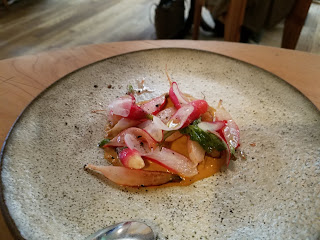
To be honest, for $8 I felt this was sort of a rip off given the amount of food. It's around maybe 7-8 small radishes. The garlic aioli-ish sauce was good, but it just seemed like so little and I'm not sure the texture of the radishes really went well with the sauce. Something crunchy in addition, perhaps some potato crisps or even deep fried radish, I think would have been much better.
4) half dozen little wing farm quail egg roti, salad greens & wagon wheel fondue

This roti dish is a pretty popular dish in the restaurant. We saw tons of tables order it. This may have been the other challenger for best course of the night. In some ways it's really simple. It's roti, with greens, eggs, and cheese. The combo of flavors and textures was just delicious. Like a much better version of a breakfast burrito (crispy/buttery roti instead of plain burrito wrap, soft cooked quail eggs instead of scrambled eggs, and mixed greens for contrast). I told my +1, they should try and turn this into some upscale breakfast burrito to be served out of a food truck. They'd sell out everyday.
5) squid ink noodles - oyster mushroom, tomato-kale dashi, & toasted sesame

I don't remember too much about this dish, other than the fact it was delicious. The sauce was really good.
6) grilled monterey bay abalone - crushed prince of orange potatoes, ramps, and yuzu-seaweed butter

It may be hard to see the bits of abalone nestled in between chunks of potato in the above photo, but they're there. There were 3 "biggish" chunks of abalone nestled in there. The abalone was perhaps the most tender abalone I've ever had in my life, just delicious along with the citrus sauce. I actually would have loved some bread to soak up the sauce from this dish, sort of like with clam juice from a clam bake.
7) wild alaskan halibut - green garlic, clams, and guanciale

So I actually didn't order this dish. Some friends at another table did. They were stuffed and told me they couldn't finish, so I went off to their table to try this dish as well. You can see the halibut buried a bit beneath the beans and clams. It was topped with a green garlic salsa-like spread, which may be hard to see in the photo as well. Overall, pretty good dish, but not my favorite, as I'm not particularly a fan of "meatier" fishes. I think I may have missed out on some of the salsa as the dish was being divided up amongst us. I will say that I loved the beans in this dish. They were fried and had a good crisp on the outside of them.
8) ricotta cake - blueberry-rose petal compote, black tea cream, candied almonds

So we had enough room to spare to grab some desserts and I had went with this ricotta cake. I had never had ricotta cake and didn't know what to assume, I had wondered if it was going to be very "cheese-cake" like. It wasn't, but it definitely was a bit "denser" than normal cake, which I liked. I couldn't really taste too much of the ricotta though. The blueberry compote was delicious and the candied almonds give some good crunch in each bite. I really liked this dish.
9) josey baker quinoa doughnuts - ginger sugar, honey-creme fraiche ice cream, rhubarb

Similar to the ricotta cake above, I didn't know what to assume of quinoa doughnuts. Once we got them, there was definitely a flavor difference, which I would describe as not-as-plain. Overall good, but not the kind of the dessert I would order again. I loved the ice cream in this dish, I think it was a great flavor and matched well with the rhubarb beneath it.
10) state bird peanut milk, muscovado syrup

Finally, we got some of this peanut milk complimentary b/c there was a slowdown in the orders earlier in the evening. It's something that's normally $3 per shot but they gave us two of them. I'm not a huge fan of peanut flavor, so this wasn't my favorite, but it wasn't too bad either. It is quite rich, so I wouldn't order one for myself in the future. Perhaps one to share would be doable.
Overall I felt it was a good meal at The Progress. Similar to other dining experiences at "gourmet casual" restaurants, there are some hits and misses. I'm hoping sometime in the future I can go with a bigger group and get one of the family style platters to share.
Nowadays, the restaurant serves a general a la carte menu, with almost everything to be served family style. The updates eventually earned the restaurant a Michelin Star in 2017.
So we decided we wanted to check out the restaurant again. The menu features several large platters that can be shared between 2-6 people, but we opted for more of the smaller dishes to try more food. Here's what we got.
1) sturgeon caviar potato cloud


First up we got this tiny appetizer. It's sized at about the size of an oyster course, so you'd want to order one per person. There's potato foam on top, some crunchy fried potato bits below, and ultimately caviar on the bottom, which you can tell in the second picture. My first taste reminded me a lot of french fries. This dish was ok, not my favorite caviar course I've ever had. I think the recollection of french fries didn't mix well with the caviar.
2) pig's head charcuterie - mandarin, fish sauce & serranos

Second up, we had what might have been my favorite course of the night. While you mostly see the charcuterie on top, beneath was (what I believed to be) shaved fennel, mint, cilantro, and slices of serrano peppers (and possibly other herbs that I missed). On top was a sprinkling of puffed rice. Overall, just a wonderful mix of flavors, textures, and that occasional hit of heat from the peppers. A part of me wondered if this could be made bigger, like in to a entree salad, but I think this was about the right size. You couldn't really do more than this.
3) radishes from our farm - smoked paprika, green garlic umami sauce

To be honest, for $8 I felt this was sort of a rip off given the amount of food. It's around maybe 7-8 small radishes. The garlic aioli-ish sauce was good, but it just seemed like so little and I'm not sure the texture of the radishes really went well with the sauce. Something crunchy in addition, perhaps some potato crisps or even deep fried radish, I think would have been much better.
4) half dozen little wing farm quail egg roti, salad greens & wagon wheel fondue

This roti dish is a pretty popular dish in the restaurant. We saw tons of tables order it. This may have been the other challenger for best course of the night. In some ways it's really simple. It's roti, with greens, eggs, and cheese. The combo of flavors and textures was just delicious. Like a much better version of a breakfast burrito (crispy/buttery roti instead of plain burrito wrap, soft cooked quail eggs instead of scrambled eggs, and mixed greens for contrast). I told my +1, they should try and turn this into some upscale breakfast burrito to be served out of a food truck. They'd sell out everyday.
5) squid ink noodles - oyster mushroom, tomato-kale dashi, & toasted sesame

I don't remember too much about this dish, other than the fact it was delicious. The sauce was really good.
6) grilled monterey bay abalone - crushed prince of orange potatoes, ramps, and yuzu-seaweed butter

It may be hard to see the bits of abalone nestled in between chunks of potato in the above photo, but they're there. There were 3 "biggish" chunks of abalone nestled in there. The abalone was perhaps the most tender abalone I've ever had in my life, just delicious along with the citrus sauce. I actually would have loved some bread to soak up the sauce from this dish, sort of like with clam juice from a clam bake.
7) wild alaskan halibut - green garlic, clams, and guanciale

So I actually didn't order this dish. Some friends at another table did. They were stuffed and told me they couldn't finish, so I went off to their table to try this dish as well. You can see the halibut buried a bit beneath the beans and clams. It was topped with a green garlic salsa-like spread, which may be hard to see in the photo as well. Overall, pretty good dish, but not my favorite, as I'm not particularly a fan of "meatier" fishes. I think I may have missed out on some of the salsa as the dish was being divided up amongst us. I will say that I loved the beans in this dish. They were fried and had a good crisp on the outside of them.
8) ricotta cake - blueberry-rose petal compote, black tea cream, candied almonds

So we had enough room to spare to grab some desserts and I had went with this ricotta cake. I had never had ricotta cake and didn't know what to assume, I had wondered if it was going to be very "cheese-cake" like. It wasn't, but it definitely was a bit "denser" than normal cake, which I liked. I couldn't really taste too much of the ricotta though. The blueberry compote was delicious and the candied almonds give some good crunch in each bite. I really liked this dish.
9) josey baker quinoa doughnuts - ginger sugar, honey-creme fraiche ice cream, rhubarb

Similar to the ricotta cake above, I didn't know what to assume of quinoa doughnuts. Once we got them, there was definitely a flavor difference, which I would describe as not-as-plain. Overall good, but not the kind of the dessert I would order again. I loved the ice cream in this dish, I think it was a great flavor and matched well with the rhubarb beneath it.
10) state bird peanut milk, muscovado syrup

Finally, we got some of this peanut milk complimentary b/c there was a slowdown in the orders earlier in the evening. It's something that's normally $3 per shot but they gave us two of them. I'm not a huge fan of peanut flavor, so this wasn't my favorite, but it wasn't too bad either. It is quite rich, so I wouldn't order one for myself in the future. Perhaps one to share would be doable.
Overall I felt it was a good meal at The Progress. Similar to other dining experiences at "gourmet casual" restaurants, there are some hits and misses. I'm hoping sometime in the future I can go with a bigger group and get one of the family style platters to share.
Thursday, May 2, 2019
Cloud Streaming Video Games
Not so long ago Google announced a new cloud streaming video game service called Stadia. Instead of consumers purchasing a console (i.e. like a Xbox or Playstation) all games would be streamed from Google's cloud infrastructure.
Sony already has such a service called Playstation Now and Microsoft has announced a future one called Xcloud.
Lots of people are speculating about whether Google's gaming platform can be a console killer, but what I found so interesting is that no one seems to be talking about Google's #1 problem, and that's games.
Any first party exclusives produced by Sony, Microsoft, or Nintendo will have zero chance of going onto Google's platform. This includes huge titles like Halo, Zelda, God of War, etc.
One presumes that any AAA third party titles (lets take as an example the Grand Theft Auto series) that will be on Stadia will presumably be on all the other platforms it currently has, such as PC, Playstation, and Xbox.
So what buy in does a consumer have to actually play games on Stadia?
1) Google has to create it's killer game.
It has started a gaming division to produce first party titles for their platform, but it's anyone's guess if they will be able to create that truly ground breaking title. Microsoft hit the jackpot with the original Xbox and Halo, but who knows if Google will be able to do the same.
2) Pricing.
This is where I think Google can actually make a difference. Google can compete on pricing and undercut their competitors in one of two ways:
A) Offer a cheaper subscription service.
In the beginning I think this is going to be an absolute requirement. As of this writing, Playstation and Xbox's subscription services have around 700 & 100 games respectively. These of course come from both company's vast library of titles. A casual glance shows that Xbox includes titles like Minecraft and Playstation has games from the God of War series. Google will likely not have a library anywhere near as good from the start, so they will have to undercut these other services.
B) Amortize the cost of a console over many games.
If consumers don't have to purchase a console to play games, this makes games net cheaper, as the savings from the lack of a console can make games net cheaper. Google has yet to announce the price of their game controller, but we can safely assume it is much cheaper than a console.
For me personally, I never actually keep games. I buy them and then sell them after I beat the game. So I spiritually "rent" games. So a subscription service from Google would be more than welcome way for me to "rent" the games I want to play. But that latter part is the kicker, it has to be something I want to play.
Sony already has such a service called Playstation Now and Microsoft has announced a future one called Xcloud.
Lots of people are speculating about whether Google's gaming platform can be a console killer, but what I found so interesting is that no one seems to be talking about Google's #1 problem, and that's games.
Any first party exclusives produced by Sony, Microsoft, or Nintendo will have zero chance of going onto Google's platform. This includes huge titles like Halo, Zelda, God of War, etc.
One presumes that any AAA third party titles (lets take as an example the Grand Theft Auto series) that will be on Stadia will presumably be on all the other platforms it currently has, such as PC, Playstation, and Xbox.
So what buy in does a consumer have to actually play games on Stadia?
1) Google has to create it's killer game.
It has started a gaming division to produce first party titles for their platform, but it's anyone's guess if they will be able to create that truly ground breaking title. Microsoft hit the jackpot with the original Xbox and Halo, but who knows if Google will be able to do the same.
2) Pricing.
This is where I think Google can actually make a difference. Google can compete on pricing and undercut their competitors in one of two ways:
A) Offer a cheaper subscription service.
In the beginning I think this is going to be an absolute requirement. As of this writing, Playstation and Xbox's subscription services have around 700 & 100 games respectively. These of course come from both company's vast library of titles. A casual glance shows that Xbox includes titles like Minecraft and Playstation has games from the God of War series. Google will likely not have a library anywhere near as good from the start, so they will have to undercut these other services.
B) Amortize the cost of a console over many games.
If consumers don't have to purchase a console to play games, this makes games net cheaper, as the savings from the lack of a console can make games net cheaper. Google has yet to announce the price of their game controller, but we can safely assume it is much cheaper than a console.
For me personally, I never actually keep games. I buy them and then sell them after I beat the game. So I spiritually "rent" games. So a subscription service from Google would be more than welcome way for me to "rent" the games I want to play. But that latter part is the kicker, it has to be something I want to play.
Wednesday, May 1, 2019
Baseball Musings One Month In
A few interesting little statistical nuggets I've noticed after 1 month into the year.
1) Miguel Cabrera
Through the month of April, Cabrera has one home run (which he hit on April 26th, pretty late) and .359 slugging percentage. Eek! Not looking good for someone owed $124 million after this season.
2) Chris Davis second half of April
Chris Davis had a horrible start to the year, leading to a record breaking streak of hitless at bats. However, since he broke that streak, he's actually been good.
First 12 games: .000/.132/.000
Next 11 games: .343/.378/.686
He hasn't played everyday, so it's possible they're only putting him in for good matchups. But maybe he can turn this around.
3) Mike Trout's Strikeout Rate
The rest of baseball should be scared. Strikeouts are perhaps Trout's one weakness, and it appears he's learning to deal with it better. Trout's struck out about 21.5% of his plate appearances before 2019. His best year was 2017 when he struck out about 17.7% of his plate appearances. This year, it's down to 11.8% of his plate appearances. Oh and his walk rate? Up to 24.4%.
1) Miguel Cabrera
Through the month of April, Cabrera has one home run (which he hit on April 26th, pretty late) and .359 slugging percentage. Eek! Not looking good for someone owed $124 million after this season.
2) Chris Davis second half of April
Chris Davis had a horrible start to the year, leading to a record breaking streak of hitless at bats. However, since he broke that streak, he's actually been good.
First 12 games: .000/.132/.000
Next 11 games: .343/.378/.686
He hasn't played everyday, so it's possible they're only putting him in for good matchups. But maybe he can turn this around.
3) Mike Trout's Strikeout Rate
The rest of baseball should be scared. Strikeouts are perhaps Trout's one weakness, and it appears he's learning to deal with it better. Trout's struck out about 21.5% of his plate appearances before 2019. His best year was 2017 when he struck out about 17.7% of his plate appearances. This year, it's down to 11.8% of his plate appearances. Oh and his walk rate? Up to 24.4%.
Tuesday, April 9, 2019
The Decline of Chris Davis
Early in this baseball season I've been following two players very closely: Mike Trout and Chris Davis.
Following Mike Trout is for obvious reasons. He's the best player in baseball and has a chance of being the GOAT in baseball.
Chris Davis is an interesting story.
From 2013 to 2015 he lead the AL in home runs twice, hitting 126 home runs over those three years. That lead him to get a 7 year contract extension for $161 million.
Since then, he has produced WARs of 3.3, 0.0, and -2.8 from 2016-2018. In 2018, he hit .168 with a .539 OPS. The .168 is the worst batting average for a position player who qualified for the batting title in about 100 years.
What happened? It's sort of interesting to look at the deeper statistics.
From 2013-2015 Davis struck out about 31% of his plate appearances. That stayed relatively consistent and was 32.9% in 2016. But it jumped to about 37% in 2017 and 2018.
His strikeout rate was about the same in both 2017 and 2018, but his batting average fell from .215 to .168. That fall of 47 points is pretty large considering his strikeout rate didn't change.
Was it due to bad luck and/or better positioning of fielders? That can explain some of it, as his batting average balls in play (BAbip) fell from .301 to .237.
But there were some additional issues.
In 2017 37.3% of his batted balls were grounders.
In 2018, it was 40.0%.
In 2017, 29.1% of his batted balls were line drives.
In 2018, it was 25.2%.
In 2017, 28.4% of his fly balls turned into home runs.
In 2018, it was 15.6%
So while there may have been some bad luck in 2018, he was hitting more ground balls (which are more likely to be outs), hitting fewer line drives (which are more likely to be hits), and he had less power in his fly balls (which turns into more outs).
That and some bad luck, and suddenly you cross the mendoza line and hit .168.
Unfortunately, 2019 is not starting off too well for Davis. He started the season going 0-28 and he recently broke the record for most consecutive at bats without a hit. On top of that, he's striking out at a 46.8% clip. Yikes!
Update 8/21/19:
A somewhat interesting aside. I had a conversation with some friends about "sunk cost fallacy" and mentioned Chris Davis. I was reminded of this article: How a Hitless Chris Davis Is Like a $15 Dessert.
In it Nobel Prize winning economist Richard Thaler states that the refusal to cut Chris Davis is the Orioles playing to the sunk cost fallacy.
However, I disagree with him in this case. (Edit: Ok, technically Orioles could be playing sunk cost fallacy, BUT what I'm really saying is there are actually reasons they may not be.) B/c the situation isn't quite the same. The classic example of sunk cost fallacy brought up in the article is:
In the MLB, you have to field a team on the field. That's an active roster of 25 / expanded roster of 40. If you were to cut Chris Davis, you'd presumably have to put someone else on the roster.
So cutting Chris Davis isn't free, compared to the basketball ticket example above. You do have to increase your team salary as a result.
Now, adding a minimum salary MLB player to your roster probably is in the noise to a MLB team. So why cut him? The article states:
Another way to think about it? If you're the worst team in baseball, why does it matter being a slightly better worst team in baseball? Or if you miss the playoffs by 40 games, what difference does it make to miss the playoffs by 37 or 38 games.
On top of that, winning a few extra games might actually be dis-advantageous. This year, the Orioles are actually "challenging" for the worst record in baseball. The Tigers (as of this writing) have lost a few extra games. That can affect the Orioles in their attempt to get a better draft pick.
Given how bad the Orioles are, it may be advantageous to just keep on playing Chris Davis in order to lose a few extra games and get that better draft pick.
Now, there are a few reasons I thought of why the Orioles might want to cut Chris Davis and use the roster spot on someone else. They all center around giving someone else a shot / experience, and using that to help the team become better long term.
1) Give some bench player / minor leaguer some more playing time.
2) Take a flyer in free agency.
3) Give a rule 5 draftee a roster spot.
Given how terrible the Orioles are, they may be reluctant to start the service clock on a number of minor leaguers earlier than necessary. #2 and #3 are effectively the same, use the roster spot as a means to acquire some talent either by giving someone a chance to turn things around (the Orioles could keep the player or and trade them for prospects) or use the rule 5 draft to acquire a prospect.
Naturally, #2 can cost a non-trivial amount of money (as an example, Matt Harvey was paid $11 million for his trial with the Angels this year), so that can only be considered when looking at the potential options in free agency.
#3 is atleast a low cost option. It costs $100K for the draftee in addition to the salary for the roster spot. So it's not free, and has to be weighed with the fact that the rule 5 draft prospects are typically not the greatest caliber prospects.
All of this has to be weighed against the fact that winning 3 or 4 more games a year may be disadvantageous towards getting a better draft pick.
So while there may be opportunities for the Orioles by cutting Chris Davis, I don't think it's entirely obvious that they should do so.
Following Mike Trout is for obvious reasons. He's the best player in baseball and has a chance of being the GOAT in baseball.
Chris Davis is an interesting story.
From 2013 to 2015 he lead the AL in home runs twice, hitting 126 home runs over those three years. That lead him to get a 7 year contract extension for $161 million.
Since then, he has produced WARs of 3.3, 0.0, and -2.8 from 2016-2018. In 2018, he hit .168 with a .539 OPS. The .168 is the worst batting average for a position player who qualified for the batting title in about 100 years.
What happened? It's sort of interesting to look at the deeper statistics.
From 2013-2015 Davis struck out about 31% of his plate appearances. That stayed relatively consistent and was 32.9% in 2016. But it jumped to about 37% in 2017 and 2018.
His strikeout rate was about the same in both 2017 and 2018, but his batting average fell from .215 to .168. That fall of 47 points is pretty large considering his strikeout rate didn't change.
Was it due to bad luck and/or better positioning of fielders? That can explain some of it, as his batting average balls in play (BAbip) fell from .301 to .237.
But there were some additional issues.
In 2017 37.3% of his batted balls were grounders.
In 2018, it was 40.0%.
In 2017, 29.1% of his batted balls were line drives.
In 2018, it was 25.2%.
In 2017, 28.4% of his fly balls turned into home runs.
In 2018, it was 15.6%
So while there may have been some bad luck in 2018, he was hitting more ground balls (which are more likely to be outs), hitting fewer line drives (which are more likely to be hits), and he had less power in his fly balls (which turns into more outs).
That and some bad luck, and suddenly you cross the mendoza line and hit .168.
Unfortunately, 2019 is not starting off too well for Davis. He started the season going 0-28 and he recently broke the record for most consecutive at bats without a hit. On top of that, he's striking out at a 46.8% clip. Yikes!
Update 8/21/19:
A somewhat interesting aside. I had a conversation with some friends about "sunk cost fallacy" and mentioned Chris Davis. I was reminded of this article: How a Hitless Chris Davis Is Like a $15 Dessert.
In it Nobel Prize winning economist Richard Thaler states that the refusal to cut Chris Davis is the Orioles playing to the sunk cost fallacy.
However, I disagree with him in this case. (Edit: Ok, technically Orioles could be playing sunk cost fallacy, BUT what I'm really saying is there are actually reasons they may not be.) B/c the situation isn't quite the same. The classic example of sunk cost fallacy brought up in the article is:
One of his favorite illustrations of sunk cost, he said, is deciding whether or not to attend a basketball game you had purchased tickets for even though attending would mean traveling through a blizzard.I don't believe this analogy applies to the Chris Davis case.
In the MLB, you have to field a team on the field. That's an active roster of 25 / expanded roster of 40. If you were to cut Chris Davis, you'd presumably have to put someone else on the roster.
So cutting Chris Davis isn't free, compared to the basketball ticket example above. You do have to increase your team salary as a result.
Now, adding a minimum salary MLB player to your roster probably is in the noise to a MLB team. So why cut him? The article states:
The team should cut Davis and replace him with a minor leaguer, as even a so-called replacement (or near average) player would represent a significant improvement.This is true. However, what's the point of it? The Orioles only won 47 games in 2018 and are pace to win about 51 this year. Cutting Chris Davis will hardly matter in the standings and the capability for this team to make the playoffs.
Another way to think about it? If you're the worst team in baseball, why does it matter being a slightly better worst team in baseball? Or if you miss the playoffs by 40 games, what difference does it make to miss the playoffs by 37 or 38 games.
On top of that, winning a few extra games might actually be dis-advantageous. This year, the Orioles are actually "challenging" for the worst record in baseball. The Tigers (as of this writing) have lost a few extra games. That can affect the Orioles in their attempt to get a better draft pick.
Given how bad the Orioles are, it may be advantageous to just keep on playing Chris Davis in order to lose a few extra games and get that better draft pick.
Now, there are a few reasons I thought of why the Orioles might want to cut Chris Davis and use the roster spot on someone else. They all center around giving someone else a shot / experience, and using that to help the team become better long term.
1) Give some bench player / minor leaguer some more playing time.
2) Take a flyer in free agency.
3) Give a rule 5 draftee a roster spot.
Given how terrible the Orioles are, they may be reluctant to start the service clock on a number of minor leaguers earlier than necessary. #2 and #3 are effectively the same, use the roster spot as a means to acquire some talent either by giving someone a chance to turn things around (the Orioles could keep the player or and trade them for prospects) or use the rule 5 draft to acquire a prospect.
Naturally, #2 can cost a non-trivial amount of money (as an example, Matt Harvey was paid $11 million for his trial with the Angels this year), so that can only be considered when looking at the potential options in free agency.
#3 is atleast a low cost option. It costs $100K for the draftee in addition to the salary for the roster spot. So it's not free, and has to be weighed with the fact that the rule 5 draft prospects are typically not the greatest caliber prospects.
All of this has to be weighed against the fact that winning 3 or 4 more games a year may be disadvantageous towards getting a better draft pick.
So while there may be opportunities for the Orioles by cutting Chris Davis, I don't think it's entirely obvious that they should do so.
Sunday, March 17, 2019
Dinner @ Mourad in San Francisco, CA
A couple of years ago I was able to hit up Mourad for a friend's birthday. I was able to dine there recently for another birthday, this time for 6 people. So we ended up ordering a lot more food than last time.
One of the coolest things they have at Mourad is a family style meal called "la'acha". Basically, it's a large family style protein served with sides. For 6 people we ordered two of them with a bunch of appetizers to share. It ended up being way more food than we could eat. This is an overview of what we had.
1) Eggplant - cucumber, oregano, pepper, flatbread, za'atar, pine nuts


We ordered two of these appetizers for the group. The flatbread was particularly delicious, which I used the soak up all of the pureed eggplant from the main dish at the top.
2) Duck liver - citrus, ginger, rye, pistachio


We got just one duck liver appetizer, which was perfect for 6 people, as each person could get about 1/2 of a scoop of duck liver on a piece of bread. Overall, quite good, although I felt the liver overpowered some of the other ingredients.
3) Octopus - brussel sprouts, cauliflower, mustard, preserved lemon

We ordered two of this appetizer for the group as well. I didn't catch what the server said about this dish, but I believe the sauce in the middle was a mushroom ju and the white sauce is a cauliflower puree of some sort. The octopus was incredibly tender and flavorful. Along with all of the sauces and the perfectly charred brussel sprouts, my favorite appetizer of the night.
4) Lamb Shoulder - tangia, moyer prune, cumin, almond, chicories

The first la'acha main dish we got was the lamb shoulder, which you can see in the middle nestled on some seasonal greens. You can also see almonds and the moyer prunes (covered in sesames) nestled on top too. It's hard to see how much food there is since a lot of it is covered it, but it was a sizable portion for 6 people and probably would have been perfect for 4 people.
The lamb was really tender and not to "lamby" compared to the lamb I normally cook up from Costco. Overall really good.
5) Chicken - preserved lemon, gaeta olive, cipollini, marash pepper

The second la'ache main we ordered was the chicken. Normally, I'm not a big fan of white meat on chicken. It's typially dry and (IMO) just not that tasty.
I took one for the team and grabbed some chicken breast so that everyone else get get more dark meat. It's probably the best chicken breast I've ever eaten in my life. It was juicy, not dry in any way, and just delicious with whatever glaze they put on top. When I told everyone at the table how good the chicken was, they didn't believe me at first. In fact, I might have preferred the white meat to the dark meat in this case.
It's worth noting at this point that there was no way the 6 of us were going to finish these two la'achas. Each was probably the perfect size for 4 people, and with the appetizers, we had left overs.
6A) Kale - olive, harissa

6B) Potato - hollandaise, preserved lemon, tarragon

6C) COUSCOUS - brown butter

6D) Heirloom beans - shakshuka, feta, sumac

The la'acha comes with the 4 sides above. I will repeat a comment my friend told me from the last time I ate here. The sides are all relatively plain ingredients, but all the little additions (hollandaise on the potatoes, preserved lemon the kale, feta on the beans, etc.) everything is just a little tastier than you would expect. Of all of the above, my favorite was the potatoes.
7) Honey & Almond - beeswax, orange blossom

We were completely stuffed after ordering too much food. Since it was a birthday dinner, we got one dessert for everyone to share and take a bite of. The waiter recommended this dish. As far as I can tell, it's a honey flavored ice cream-ish thing (searching online it might be sabayon), with almond granita, and some crispy bits on top. Overall, I loved the flavors in this dish, really good.
8) Sesame fudge

Finally we got some mignardise (I took the picture after many pieces were yoinked), which was some sesame fudge bites. After biting into it, it immediately reminded me of several Chinese flavored desserts that have sesame flavor. Overall, really really good.
Overall, a great meal at Mourad. I can't recommend it enough. The price is not too exorbitant given the quality of the food that you're getting, especially when getting the la'acha family meals.
One of the coolest things they have at Mourad is a family style meal called "la'acha". Basically, it's a large family style protein served with sides. For 6 people we ordered two of them with a bunch of appetizers to share. It ended up being way more food than we could eat. This is an overview of what we had.
1) Eggplant - cucumber, oregano, pepper, flatbread, za'atar, pine nuts


We ordered two of these appetizers for the group. The flatbread was particularly delicious, which I used the soak up all of the pureed eggplant from the main dish at the top.
2) Duck liver - citrus, ginger, rye, pistachio


We got just one duck liver appetizer, which was perfect for 6 people, as each person could get about 1/2 of a scoop of duck liver on a piece of bread. Overall, quite good, although I felt the liver overpowered some of the other ingredients.
3) Octopus - brussel sprouts, cauliflower, mustard, preserved lemon

We ordered two of this appetizer for the group as well. I didn't catch what the server said about this dish, but I believe the sauce in the middle was a mushroom ju and the white sauce is a cauliflower puree of some sort. The octopus was incredibly tender and flavorful. Along with all of the sauces and the perfectly charred brussel sprouts, my favorite appetizer of the night.
4) Lamb Shoulder - tangia, moyer prune, cumin, almond, chicories

The first la'acha main dish we got was the lamb shoulder, which you can see in the middle nestled on some seasonal greens. You can also see almonds and the moyer prunes (covered in sesames) nestled on top too. It's hard to see how much food there is since a lot of it is covered it, but it was a sizable portion for 6 people and probably would have been perfect for 4 people.
The lamb was really tender and not to "lamby" compared to the lamb I normally cook up from Costco. Overall really good.
5) Chicken - preserved lemon, gaeta olive, cipollini, marash pepper

The second la'ache main we ordered was the chicken. Normally, I'm not a big fan of white meat on chicken. It's typially dry and (IMO) just not that tasty.
I took one for the team and grabbed some chicken breast so that everyone else get get more dark meat. It's probably the best chicken breast I've ever eaten in my life. It was juicy, not dry in any way, and just delicious with whatever glaze they put on top. When I told everyone at the table how good the chicken was, they didn't believe me at first. In fact, I might have preferred the white meat to the dark meat in this case.
It's worth noting at this point that there was no way the 6 of us were going to finish these two la'achas. Each was probably the perfect size for 4 people, and with the appetizers, we had left overs.
6A) Kale - olive, harissa

6B) Potato - hollandaise, preserved lemon, tarragon

6C) COUSCOUS - brown butter

6D) Heirloom beans - shakshuka, feta, sumac

The la'acha comes with the 4 sides above. I will repeat a comment my friend told me from the last time I ate here. The sides are all relatively plain ingredients, but all the little additions (hollandaise on the potatoes, preserved lemon the kale, feta on the beans, etc.) everything is just a little tastier than you would expect. Of all of the above, my favorite was the potatoes.
7) Honey & Almond - beeswax, orange blossom

We were completely stuffed after ordering too much food. Since it was a birthday dinner, we got one dessert for everyone to share and take a bite of. The waiter recommended this dish. As far as I can tell, it's a honey flavored ice cream-ish thing (searching online it might be sabayon), with almond granita, and some crispy bits on top. Overall, I loved the flavors in this dish, really good.
8) Sesame fudge

Finally we got some mignardise (I took the picture after many pieces were yoinked), which was some sesame fudge bites. After biting into it, it immediately reminded me of several Chinese flavored desserts that have sesame flavor. Overall, really really good.
Overall, a great meal at Mourad. I can't recommend it enough. The price is not too exorbitant given the quality of the food that you're getting, especially when getting the la'acha family meals.
Thursday, February 21, 2019
Poor reviews for Fallout 76 & Anthem
I have not played either Fallout 76 or Anthem. However, I've been following the comments and reviews online, and find their reception very interesting.
Both games come from storied RPG developers. Fallout 76 coming from Bethesda, the makers of Fallout 3, Fallout 4, and the Elder Scrolls series. Anthem comes from Bioware, the creators of the Dragon Age and Mass Effect series.
Both companies have storied history creating incredible worlds and stories, but they've all been single-player RPG experiences.
It's very interesting that both made a decision to create a multiplayer RPG at some point in the last 5 years, and both released it in about a 3 month window of each other.
And both games have not been received as well as their prior single player RPGs.
Lets start with Fallout 76, which was released in November 2018. The game is averaging a review of about 50/100 on most of the review aggregator sites. It puts the game squarely in the "poorly reviewed" category, it's not even close to "mixed reviews".
As far as the reviews go, it seems that the general commentary is that by taking a single player game that concentrated on story (including quests, NPCs, etc.) and turning it into a multi-player game where you interact with other humans, just made the game terrible. Unlike MMORPGs, by trying to mix multi-player into a single-player like gameplay just didn't work. Other human players were simply not as interesting as NPCs.
In addition, the single player Fallouts weren't considered good shooter games. But one has to remember they don't have to be. The primary focus of the game was on the solo-story aspect. So the shooting mechanism was there as a necessary way to fight enemies. But transform that into a multi-player shooter, and the reality is there are a many better shooters out there.
Add in a bunch of bugs, and you have a game getting an F grade overall.
The story of Anthem's reviews seems much the same, although not quite as bad. The review averages seem to be converging in the low 60s range on aggregator sites, so it's just hanging onto the "mixed review" territory.
Bioware attempted to make a multi-player shooter, but have a solo-RPG story for the user. Most of the reviews thus far have panned the mixture.
The reviews of the shooter aspects of the game are generally good, but the story and the purpose of the game have been heavily criticized.
Although I cannot find the review, the best comment was one that stated that if the game were only a shooter game, it probably would be ok. Imagine you are playing the game with friends (b/c its multiplayer). In most shooter games, you go shoot things, get loot / win / whatever, then try to shoot more things again.
But it completely fell apart in Anthem. Instead, you go shoot things, get loot, have to go walk around a city by yourself, talk to people (by yourself), then go configure your fighter (by yourself), then eventually after many minutes, you can go shoot more things. If this is a multi-player game, how are you supposed to enjoy playing with your friends when you have to run around by yourself so much?
There are other criticisms that aren't important to go into (weak story, poor missions, etc.). Add in the fact that the shooter game doesn't even have PvP, then people begin to wonder what kind of game it is. Now you have a game that is averaging around a D- grade.
I find it so interesting how both Bethesda & Bioware went the multi-player route with poor results.
Was there industry pressure to create multi-player games even though their experience was single player? To have microtransactions in games?
Yet, to appease their fanbase, to try and add a similar single player RPG experience into the game?
Naturally, one then wonders how these companies will react given the bad reviews of these multiplayer games. Will they go back and try to create a new / great single-player RPG? Or will they dig in their heels and continue with multiplayer going forward?
Both games come from storied RPG developers. Fallout 76 coming from Bethesda, the makers of Fallout 3, Fallout 4, and the Elder Scrolls series. Anthem comes from Bioware, the creators of the Dragon Age and Mass Effect series.
Both companies have storied history creating incredible worlds and stories, but they've all been single-player RPG experiences.
It's very interesting that both made a decision to create a multiplayer RPG at some point in the last 5 years, and both released it in about a 3 month window of each other.
And both games have not been received as well as their prior single player RPGs.
Lets start with Fallout 76, which was released in November 2018. The game is averaging a review of about 50/100 on most of the review aggregator sites. It puts the game squarely in the "poorly reviewed" category, it's not even close to "mixed reviews".
As far as the reviews go, it seems that the general commentary is that by taking a single player game that concentrated on story (including quests, NPCs, etc.) and turning it into a multi-player game where you interact with other humans, just made the game terrible. Unlike MMORPGs, by trying to mix multi-player into a single-player like gameplay just didn't work. Other human players were simply not as interesting as NPCs.
In addition, the single player Fallouts weren't considered good shooter games. But one has to remember they don't have to be. The primary focus of the game was on the solo-story aspect. So the shooting mechanism was there as a necessary way to fight enemies. But transform that into a multi-player shooter, and the reality is there are a many better shooters out there.
Add in a bunch of bugs, and you have a game getting an F grade overall.
The story of Anthem's reviews seems much the same, although not quite as bad. The review averages seem to be converging in the low 60s range on aggregator sites, so it's just hanging onto the "mixed review" territory.
Bioware attempted to make a multi-player shooter, but have a solo-RPG story for the user. Most of the reviews thus far have panned the mixture.
The reviews of the shooter aspects of the game are generally good, but the story and the purpose of the game have been heavily criticized.
Although I cannot find the review, the best comment was one that stated that if the game were only a shooter game, it probably would be ok. Imagine you are playing the game with friends (b/c its multiplayer). In most shooter games, you go shoot things, get loot / win / whatever, then try to shoot more things again.
But it completely fell apart in Anthem. Instead, you go shoot things, get loot, have to go walk around a city by yourself, talk to people (by yourself), then go configure your fighter (by yourself), then eventually after many minutes, you can go shoot more things. If this is a multi-player game, how are you supposed to enjoy playing with your friends when you have to run around by yourself so much?
There are other criticisms that aren't important to go into (weak story, poor missions, etc.). Add in the fact that the shooter game doesn't even have PvP, then people begin to wonder what kind of game it is. Now you have a game that is averaging around a D- grade.
I find it so interesting how both Bethesda & Bioware went the multi-player route with poor results.
Was there industry pressure to create multi-player games even though their experience was single player? To have microtransactions in games?
Yet, to appease their fanbase, to try and add a similar single player RPG experience into the game?
Naturally, one then wonders how these companies will react given the bad reviews of these multiplayer games. Will they go back and try to create a new / great single-player RPG? Or will they dig in their heels and continue with multiplayer going forward?
Subscribe to:
Posts (Atom)