It was recently announced that the Baseball Hall of Fame class of 2019 would include Mariano Rivera, Edgar Martinez, Mike Mussina, and Roy Halladay.
What's interesting is how many players have been voted in in recent years after a big donut in 2013.
2014 - Maddux, Glavine, Thomas
2015 - Johnson, P. Martinez, Smoltz, Biggio
2016 - Griffey Jr., Piazza
2017 - Bagwell, Raines, Rodriguez
2018 - Jones, Guerrero, Thome, Hoffman
2019 - Rivera, E. Martinez, Mussina, Halladay
That's 4 players in each of the last two years, atleast 3 in 5 of the last 6 years, for a total of 20 in the last 6 years. In contrast, there were only 9 players elected from 2007-2012 (and again, there were zero in 2013).
However, things are looking slim for awhile. Assuming that PED connected layers like Bonds, Clemens, and Sosa, and controversial players like Schilling won't get to 75%, here's what looks like the strong and maybe cases until 2023.
2020 - Jeter is a lock, Bobby Abreu is a medium candidate
2021 - Tim Hudson is the best of a weak new set of candidates
2022 - Alex Rodriguez has PED connections, David Ortiz is a strong consideration
2023 - Carlos Beltran is a medium-strong candidate
Discounting players connected to PEDs, I would say there were 5-6 locks amongst the 2013-2019 group, and 5-6 medium to strong candidates. But the 2020-2023 group looks a little thin. Only 1 lock with Jeter, and Ortiz & Beltran the only minimally medium-ish candidates (discounting the PED connected A-Rod).
I was curious which players retired after the 2018 baseball season, because they would be eligible for the 2024 HOF vote. 2024 is when the HOF voting should pick up again. The 2024 additions could be Ichiro Suzuki, Adrian Beltre, Joe Mauer, and Chase Utley. I would consider Suzuki a lock, Beltre, a "very strong", Mauer a medium-strong, and Utley atleast medium (he could hover like Jeff Kent has). Suzuki hasn't officially retired yet, so it's possible he would be included in the 2025 HOF vote, but things should definitely pick up after 2023.
Thursday, January 24, 2019

Wednesday, January 9, 2019
Milk / Cream With Egg Desserts
Some time ago someone had mentioned to me how they thought Chinese egg tarts (dan tat) were a bit of a weird dessert. I said something to the effect, "Do you think creme brulee is a weird dessert?" They responded no, then I said, "then it's not a weird dessert, you're just not used to that kind of dessert at a Chinese restaurant or with dim sum."
The conversation then moved into the differences between various milk / cream with egg desserts. The reality is so many desserts have only minor variations from each other. So the weirdness really comes from the unfamiliarity with it in a certain cuisine or in a certain restaurant.
I was reminded on this conversation after making some pot de creme and decided to recall the differences. The internet is not too helpful on some of the detailed differences (everyone has their own recipe, globalization / commercialization has changed recipes over the years), but here's my minimally researched summary on all the differences.
The main difference between all of these desserts is the ratio of milk, cream, sugar, and eggs (and if it uses egg yolks or whites or both). I don't mention the ratios or the specific cooking technique, it's just to give the basics. I don't mention flavoring, which all of the below can add whatever flavoring you want (vanilla, chocolate, lemon, etc.).
Here we go with the dessert list.
custard - milk / cream & sugar and egg yolks used to thicken it
creme brulee - custard with a caremalized sugar topping
flan - custard with a caramel sauce topping
pot de creme - a lighter custard
pastry cream - an even lighter custard, usually done by using only milk and/or using only egg whites. Use this in ...
cream puff - pastry with pastry cream in it
bavarian cream - pastry cream, but add whipped cream to make it lighter.
mousse - like custard, but instead of cream / egg straight up, add whipped cream / whipped egg whites to make it lighter and airier.
semifreddo - mousse but you freeze it
ice cream / frozen custard - you basically start with a custard, then you churn / freeze it (modern day ice creams in stores may not add eggs, as they may use other thickeners)
gelato - different ratios than ice cream, leading to denser / less airy form
Portuguese egg tart / pastel de nata - custard in a puff / pie crust, and slightly caramelized on top
so ... how is Chinese egg tart different?
Chinese egg tart (dan tat) - custard in a puff / pie crust, usually less sweet. No caramelization on top compared to pastel de nata. The internet can't seem to agree if the custard is denser or lighter, I'm sure every restaurant / region has a variation.
And I'll add one more Chinese dessert that hasn't really gotten a foothold in Western countries.
Chinese steamed pudding - milk with egg whites as thickener
at the end of the day? How different are these desserts really?
To finish up this post, for fun, how about a few other desserts that are similar, but just use non-eggs as thickeners.
pudding - milk & sugar with flour / cornstarch used as thickener
panna cotta - milk / cream & sugar and gelatin as thickener
Friday, December 28, 2018
Tasty Stuff I Ate in 2018
Last year I missed out posting a miscellaneous "tasty stuff" post like I did in 2016, 2015, and 2014. I simply did not wander into enough hole in the wall restaurants to put together a post.
However, by visiting a ton of places in Asia this year, I have plenty to write about this year. So here's a list of random tasty stuff I ate in 2018 that didn't get into one of my bigger restaurant write ups.
1) Noodles & Wontons @ Mak Man Kee Noodles (Hong Kong, China)

There are many "Mak's" noodles in Hong Kong. I know that there is a lineage between a very famous chef, his proteges/family members, and all of the "Mak's" noodles around the town. I don't know this particular restaurant's lineage, but I can say the noodles were delicious. There's a good "chew" to the noodles that doesn't really exist in more mass manufactured ones.
2) Congee @ Fu Kee Congee (Hong Kong, China)

While there are other famous congee places in Hong Kong, this is the one me and my +1 liked the most. I don't know what they did to make the broth (i.e. it's clearly not just water), but it was delicious.
3) Steamed Milk Pudding @ Yee Shun (Hong Kong, China)

Before my trip to Hong Kong, I don't think I ever had this dish before. But after trying it, I was hooked. The above pic is the ginger flavored one, which gave it just a bit of a zing along with the milk. But the plain one was delicious too.
4) Fish curry balls & wontons @ Block 18 Doggie's Noodle (Hong Kong, China)

This street stall in Hong Kong is pretty famous for their noodles, but I couldn't get over the fish curry balls & wontons (they are separate orders, but they put it in the same togo container). Spicy and with tons of flavor, way more than any curry fish balls I have ever tried before. And the wontons had these wonderful chewy texture that I loved.
5) Shrimp @ Chuen Cheng (Taipei, Taiwan)

So Chuen Cheng in Taiwan is most famous as a shrimp fishing bar/restaurant. I believe Anthony Bourdain went there during his Taipei No Reservations segment. Many guides online go over the fact you can rent a pole, fish for shrimp, and grill up your catch in the back (just search "taiwan shrimp fishing" to learn more).
Unknown to us until seeing a sign (it's not in English), you can actually pay the staff to cook the shrimp for you if you don't want to do it yourself on the grill. And you can have it cooked in many different ways. We just asked for a recommendation and they picked this, which was stir fried with some type of lemony kind of sauce. Delicious because the shrimp were so large and fresh, but the lemony taste imbued into the shrimp.
6) mandu @ Myeongdong Kyoja (Seoul, Korea)

Myeongdong Kyoja is most famous for their noodle soups, but I was more blown away by their dumplings. Larger than most Chinese style dumplings, they have a really thin skin that sort of "hugs" the meatball inside.
7) Kiawe Wood Smoked Heritage Pork and haupia tart @ aina (San Francisco, CA)


Had a great dinner at aina this year, and they're going to get 2 dishes mentioned.
I'm not the biggest fan of pork, perhaps having eaten too many dry and overcooked versions in my life, but this was the most tender and delicious pork I've ever had. I assume it was sous vided and then smoked? I have no idea. Along with the ginger chimichurri, the dish was amazing.
The other dish I'll mention is the dessert. The menu lists coconut pudding, coconut shortbread, and sweet potato vinegar ice cream in this tart. Some macerated berries were on there as well. An incredible mixture of flavors and some good crunch from the shortbread. The ice cream was particularly delicious, which would not have been expected ... b/c it's vinegar flavor.
Tuesday, November 6, 2018
IBM acquisition of Redhat
True story, my wife and I were watching TV when my wife asked, "What's Redhat?". I then explained that Redhat was a company that (loosely) packaged open source software together and sold support for it. Because my wife was familiar with Cloudera, I told her that it was the Cloudera of the Linux operating system world.
Then she blew me away by then asking, "Why would IBM want to buy them for $30 billion dollars?"
As a software developer that has worked almost exclusively on Linux in his career, it was a huge announcement.
After sitting back and pondering it for awhile, I was beginning to think about the move and it was a good move by IBM.
In my opinion, it is a great move for IBM. But the probability of it being a success is low.
In one article I read, a Redhat engineer said: "I can't imagine a bigger culture clash." I think that pretty much sums up the thoughts of myself and many other engineers.
Here were some differences I thought about after the sale was announced:
I read a tweet (which I'm having trouble finding), but it said something to the effect:
Then she blew me away by then asking, "Why would IBM want to buy them for $30 billion dollars?"
As a software developer that has worked almost exclusively on Linux in his career, it was a huge announcement.
After sitting back and pondering it for awhile, I was beginning to think about the move and it was a good move by IBM.
In my opinion, it is a great move for IBM. But the probability of it being a success is low.
In one article I read, a Redhat engineer said: "I can't imagine a bigger culture clash." I think that pretty much sums up the thoughts of myself and many other engineers.
Here were some differences I thought about after the sale was announced:
- IBM engineers are typically told to be wary of the GPL to avoid potential code pollution, Redhat engineers work with the GPL all of the time
- IBM often requires signed license agreements for code contributions to their code base, Redhat works with the open source community on tons of things as is
- IBM legal likes to get their hands into the middle of many things
I read a tweet (which I'm having trouble finding), but it said something to the effect:
- IBM just paid 30% of their market cap for Redhat
- Redhat's headcount is only 3% of IBM's
- Unlike IBM, Redhat does not really have much intellectual property (IIRC, IBM has the largest patent portfolio of any US company)
- Unlike IBM, Redhat does not really have much capital assets
- Unlike IBM, Redhat gives away its product for free
- Unlike IBM, Redhat employees can leave Redhat and take leadership of their product with them
Sunday, November 4, 2018
Dining @ Trestle in San Francisco, CA
About two years ago I dined at Trestle and loved it. For a very affordable price (nowadays $38 dollars), you can get a good three course price fixe meal. For an extra $10 you an add an additional pasta course. For San Francisco, it's a great deal for a meal. It's regularly been listed in Michelin's Bib Gourmand listings for years and the San Francisco chronicle's top 100 restaurants list.
Here's what we had this time around. It's worth noting that you can request some bread, but we had a late lunch and elected not to have any.
1A) Leek & Fennel Soup - Fingerling Potato, Black Pepper Crème Fraîche, Caviar

1B) Pear & Chicory Salad - Guava, Coriander-Lime Yogurt, Pecans, Ginger Vinaigrette

I had the soup on the top while my +1 had to the salad on the bottom. The soup was rich, hearty, and delicious. There were potatoes, creme fraiche, and caviar in the soup. My assumption is that potato was used as the thickener for the soup as well.
Unfortunately, I can't comment on the salad as I didn't try it because I'm allergic to guava.
2) Garganelli Pasta & Shrimp - Bottarga, Spicy Tomato, Basil, Caper

Not much to really say about this dish, as it was good. The pasta was perfectly al dente.
3A) Ginger-Scallion Crusted Salmon - Swiss Chard, Shiitake Mushroom, Huckleberries, Butternut Squash

3B) Pork Loin - Persimmon, Braised Savoy Cabbage, Mustard Jus

I had the salmon on top while my +1 had the pork loin below. Just like my last visit to Trestle, the salmon was absolutely amazing. It was barely raw in the middle and perfectly soft. The ginger / scallion crust was crisp and added a good hit of flavor in the middle of bites. This is despite the fact I'm not a big fan of salmon. (Although, at some point, I'm going to have to realize that my general dislike of salmon may simply be that I need to have really good salmon more times.)
Of the few bites of pork loin i tried from my +1s, it was also quite good, although not quite as good as the pork loin I had from a recent trip to aina.
4A) Anson Mills Polenta Cake - Kaffir Lime, Satsuma Mandarins, Meyer Lemon

4B) Milk Chocolate Custard - Pomegranate, Pinenuts, Kabocha Squash

I had never had polenta as a dessert before, but this the polenta cake was delicious. I'm having trouble describing the texture, but it was certainly something I hadn't had in a dessert before. Along was the citrus sauce and orange chunks on the side, it was delicious. My immediate thought was I had to try and bake this at home.
The milk chocolate custard below was also good, although I felt it was a bit rich after a few bites.
Overall, another great meal at Trestle. Can't wait to hit it up again. It's worth noting that we were in and out of Trestle in about 1.5 hours. So it's a pretty quick meal as well.
Saturday, June 16, 2018
Is Chinese Food Culturally Disadvantaged for Food Critics?
Watching an old Anthony Bourdain episode, I came upon the name Fuchsia Dunlop, a chef/writer specializing in Chinese cuisine.
I began reading some of her stuff online and watching some videos from her, and she brought up a point about food reviewers and Chinese food that blew my mind. She's said the point several times, but for reference here's one place she brings it up on her blog.
The high point of Chinese cuisine is really the banquet meal, served family style, which requires minimally 8-10 people, but of course can go as high as hundreds of people (such as at wedding or a large celebration).
But food reviewers are typically 1 person, maybe 2 max.
So how does a food reviewer judge a high-end Chinese restaurant?
She suggests that Chinese cuisine has a disadvantage in the global culinary landscape because most reviewers won't be reviewing what is considered top Chinese cuisine. In contrast, compare this to the tasting menus that usually top western restaurants serve. Those menus can easily be served to a lone diner or a couple.
Here's another way to look at it as I thought about it more.
Since banquet meals can sometimes get large (i.e. for weddings), many top Chinese restaurants can seat hundreds of people. It's the reality of the business.
Needless to say, these restaurants need to generate business when they don't have large banquets going on. So they offer a large variety of menu options for the a la carte diner, possibly over 100+ dishes. As a sample, I counted 130+ menu items at Lung King Heen, a 3 Michelin Star Chinese restaurant in Hong Kong, and that doesn't count dim sum items for lunch or the items on their tasting menu.
So how does a reviewer review such a restaurant? Only on the banquet meal? Or random a la carte items? Is the restaurant graded on some small subset of random a la carte items?
When reading reviews from Andy Hayler, he has given many Chinese restaurants poor reviews, wondering how they could have received Michelin stars.
So one might ask, how is Michelin reviewing high end Chinese restaurants? Are they only reviewing the banquet meals? The tasting menus (if offered)? Are they reviewing a random subset of a la carte items? The Michelin guide has stated before that they care about "every dish" being wonderful, but are all their reviewers really reviewing all 130+ items at Lung King Heen? I doubt it.
Oh, I didn't yet bring up how a restaurant with 100+ seats and 100+ items is disadvantaged on culinary reviews. It's far easier to concentrate on amazing flavors and to be very consistent at it when you have only 20 seats, 10 kitchen staff, and a menu of 10 items.
I thought Fuchsia Dunlop made an incredible point about how an entire country's cuisine simply might be disadvantaged in the international culinary landscape. But this doesn't appear to be a West vs East issue. For example, Japanese cuisine has had kaiseki meals for hundreds of years. So they can be reviewed very easily by one reviewer. I'm sure this problem isn't unique to just China either.
As time goes on (which was actually brought up in the Part's Unknown episode), what will likely happen is tasting menu only Chinese restaurants will appear over time, as that style becomes more popular in China as people begin to experience Western style tasting menus. The same will likely happen in Western countries too as higher end Chinese food spreads in popularity. I recall that one Chinese tasting only menu in San Francisco just opened up.
Friday, June 15, 2018
Dining @ Mingles in Seoul, Korea
While in Seoul we wanted to go on a food adventure. Unlike Hong Kong (but similar to Tokyo), it seemed to be harder for a non-local to get reservations. While its not surprising to find restaurants without English on their website, I found it even more surprising that a nice chunk of restaurants didn't even have websites.
So with some English and minimally e-mail reservations a requirement, as well as getting a meal that is Korean or Korean fusion (i.e. no pure Japanese, Chinese, or European food), I eventually got reservations @ Mingles.
Mingles is one of the most talked about restaurants in Seoul and listed on pretty much all of the "best restaurants in Seoul" lists I found. At the time of this writing, they're listed as the #11th best restaurant in Asia on the Top 50 Asia list, are #89 on the Overall Top 50 list in 2017, and got 1 Michelin Star.
For anyone who may be wondering how I got reservations, I e-mailed Mingles via the e-mail address on their website. They take reservations 1 month ahead of date on the 1st of the month (i.e. for a June 10th reservation, you can e-mail them on May 1st). From what I read online, reservations can be hard, so you should e-mail them early. There's a $100 USD deposit via Paypal for reservations. You are refunded this deposit when you show up. In addition, about 48 hours ahead of your reservation, you have to e-mail them to let them know you're coming (i.e. b/c you probably don't have a local phone number for them to re-verify the reservation).
The menu at Mingles is a set tasting menu with a few options for the main and dessert. There are also some additional courses you could pay more to simply add on. I wanted to try the extra courses but wasn't sure if it would be too much food. The waiter recommended we share these additional courses so as to not get too stuffed. Of the extras, there was 1 consomme / vegetable dish, 1 noodle dish, and 1 broth / noodle dish. We ordered the first two to avoid too much cross over (i.e. not two soups, not two noodles). But I think we could have ordered all three and still not left overly stuffed.
Here's what we got.
1) Amuse #1

The first amuse course we got was beef tartare. It was set in between two different seaweed crackers, one sweetened and one not. A good amuse, a nice texture difference and the sweetness from the second seaweed didn't overpower.
2) Amuse #2


The next set of amuse dishes started off with a corn soup, with crab and some type of vegetable. I'm not sure what kind of vegetable it was, but I really enjoyed it.
The tuna carpaccio came with some seaweed paste and some pickled vegetable.
I really enjoyed the tuna carpaccio. I'm not sure what type of tuna this was, but it was delicious with the seaweed paste.
3) Summer - Summer clam carpaccio, seasonal herb pesto, asparagus

This was the first official course on the menu, with clam underneath this pile of asparagus. The staff said the pesto was made with some korean herb that I don't know. Overall, tasty and a good refreshing dish.
4) Zucchini - Zucchini Seon, Zucchini consomme

This dish was one of the two extra courses we ordered. It's small enough that we probably should have both gotten one instead of sharing it. It's some cleverly plated zucchini (two types) in a consomme of zucchini and pumpkin. Good and light.
5) Abalone - steamed abalone with dashima, napa cabbage soon, and zepi broth


Next up we have this abalone steamed in kelp, nestled on top of some cabbage in a broth. I'm not sure what a "soon" is and what "zepi" is. Some minimal online Googling has not gotten me far. I will say that the dish was delicious. The broth definitely had some flavor that was wonderful, but I was not familiar with.
Included in this dish was some rice cakes to absorb the broth up when we were done. The rice cakes were also stuffed with abalone and shrimp.
6) Jeju Island - fresh seafood & zucchini flower from jeju island

So this fish was apparently croaker, along with some bamboo, a stuffed zucchini flower (the staff said stuffed with shrimp and pumpkin), and beneath this all was some anchovy risotto. Overall, the fish was delicious but I especially loved the risotto. There were little fruit chunks in the risotto that gave it a contrasting texture and flavor I really enjoyed compared to most risotto.
7) Fish Mandu - mingles fish mandu that is reinterpreted Korean court food

Another great dish, the fish was flavorful and stuffed with (I believe) zucchini and shrimp. To the right is white asparagus and based on the taste, I think the broth is clam or oyster based (although probably has some fish in there too).
8) Jang Noodle - squid ink & seaweed jang sauce, seasonal sea food and mingle's style pasta

This was our second extra course of the night, so we shared this semi-large dish.
This was delicious, probably my favorite of the night. These noodles were delicious, with good texture, and far better than the typical trash squid ink noodles I've eaten. The seaweed jang added some good umami flavor. On top is lobster and uni. The lobster was amazingly tender, I'm not sure what they did to manipulate the lobster to give it that tenderness of if its some variant lobster breed in Korea.
9) Egg Custard

This is apparently a signature dish from the restaurant. I missed the details the staff said when describing the dish. I picked up truffle while eating it. Online, various ingredients are listed, it might be the case that this dish is altered depending on the season. There were some crunch bits at the bottom, that might have been chorizo.
I was a little surprised when I dug into the egg, as the white above is mostly foam. I was expecting something "thicker", so I think I messed up and didn't quite collect all of the flavors at the same time. Some good flavor here, but the foam sort of threw me off.
10A) Lobster - Organic Vegetables from Junhyuk's Farm, egg yolk-doenjang sauce

So I missed a lot of the details the staff said when they brought out the dish, so I'm not sure what the sauce in the middle was. But going off the menu, it's a combo of egg yolk with doenjang, a fermented bean paste. Regardless, it was tasty. The lobster was tender and not as chewy as I'm normally used to, although had more chew than the lobster in the jang noodles above. Unsure if that's due to the cooking technique or a different lobster type. Either way, very good. Off to the upper left is a whole bunch of squash, tomato, and something I'm unsure of. It looks like leek, but had a starchy texture. Perhaps some potato or yam that was put into a swirl.
10B) Korean Beef - Charcoal grilled 1++Striploin with soy sauce

My +1 got the steak and of the few pieces I tasted, it was absolutely amazing. I don't know what cow this came from, it wasn't wagyu / kobe, but it was incredible. The sauce was made with soy sauce, citrus, and truffle, although I don't know what the white stuff in the middle is. There's also some potato and carrot.
11) Vegetable - Cold soy bean soup, seaweed noodle & tomato tart


Next up we had a (I think) traditional soy bean soup that had seaweed noodles and some other vegetables in it (I recall cucumber and a lima-bean-ish bean). I tried cold soy bean soup for the first time during my trip to Korea, and this was probably the second time I ever had it in my life, so it's a little hard to judge. It tasted fine I guess.
The tomato tart apparently had tofu in it as well, but we couldn't quite pick it up. We were wondering if it was not what we thought of tofu, but some alternate soy product. Overall, pretty good.
13) Fruit / Palatte Cleanser
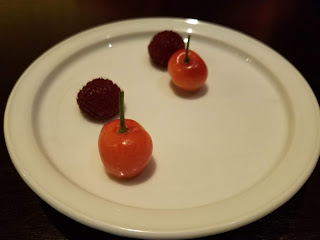
This was brought out as (what I assume) was a palate cleanser of sorts before dessert. It's a cherry and what I believe is called "mountain strawberry", although it looks more like a raspberry.
14A) Jang Trio - Doen-Jang creme brulee, gan-jang pecan, gochu-jang blackrice, vanilla ice cream, whisky foam

So I had to look a lot of this stuff up, doenjang is a soybean paste, ganjang is soy sauce, and gochujang is red chili paste. I guess the ganjang was used to marinated the pecans and the gochujang was used to flavor the rice above. Included on top were also the ice cream and whisky foam.
While I have little knowledge of "jang", I loved this dessert. All the different textures and flavors mixed together were wonderful, the ice cream being thick, the whisky foam being foamy, the crunch of the brulee at the bottom, and all the rice and pecan textures. Just delicious, it'll definitely crack my top ten desserts of all time.
14B) Summer Citrus - hallabong (jeju orange) sorbet, mango, orange, lemon basil compote, creme anglaise

So I can't comment on this dish because I didn't try it b/c of my tropical fruit allergy. My +1 said she loved this dessert. She said the sorbet was more foam-ish than sorbet-ish.
15) Sweets

Finally the mignardise. Some cookies at the top, some type of root flavored jelly at the left (Korean ingredient I'm not familiar with), and some sesame cookies on the right. They also served us tea as part of the meal, which I won't bother to post a picture of.
Overall, this meal was wonderful and I can understand why it's ranked so highly. This reminded me a lot of my meals at Benu and VEA, a French / Western styled meal with strong Asian influence, in this case specifically Korean influences.
Unlike those other meals, I was not as familiar with Korean food or Korean ingredients and did not get as much emotionally out of this meal. Minimally I didn't know a number of ingredients, and without the Korean cuisine knowledge base, it's hard to know where some of the dishes/ingredients/reinterpretations are coming from (e.g. the fish mandu or the soy bean soup). If you read the details in my pictures, you can tell I missed a lot. Perhaps the next time I visit Seoul, I'll be more prepared and can appreciate the cuisine far more.
It's worth noting the price of the meal as well. In USD, this meal would be a little under $300 for two people if no extras and no drinks were ordered. That's a pretty good price given this restaurant's reputation. Even with the additional supplements we paid (two extra shared courses, lobster supplement, beef supplement), the price still came to about $335 USD without drinks.
So with some English and minimally e-mail reservations a requirement, as well as getting a meal that is Korean or Korean fusion (i.e. no pure Japanese, Chinese, or European food), I eventually got reservations @ Mingles.
Mingles is one of the most talked about restaurants in Seoul and listed on pretty much all of the "best restaurants in Seoul" lists I found. At the time of this writing, they're listed as the #11th best restaurant in Asia on the Top 50 Asia list, are #89 on the Overall Top 50 list in 2017, and got 1 Michelin Star.
For anyone who may be wondering how I got reservations, I e-mailed Mingles via the e-mail address on their website. They take reservations 1 month ahead of date on the 1st of the month (i.e. for a June 10th reservation, you can e-mail them on May 1st). From what I read online, reservations can be hard, so you should e-mail them early. There's a $100 USD deposit via Paypal for reservations. You are refunded this deposit when you show up. In addition, about 48 hours ahead of your reservation, you have to e-mail them to let them know you're coming (i.e. b/c you probably don't have a local phone number for them to re-verify the reservation).
The menu at Mingles is a set tasting menu with a few options for the main and dessert. There are also some additional courses you could pay more to simply add on. I wanted to try the extra courses but wasn't sure if it would be too much food. The waiter recommended we share these additional courses so as to not get too stuffed. Of the extras, there was 1 consomme / vegetable dish, 1 noodle dish, and 1 broth / noodle dish. We ordered the first two to avoid too much cross over (i.e. not two soups, not two noodles). But I think we could have ordered all three and still not left overly stuffed.
Here's what we got.
1) Amuse #1

The first amuse course we got was beef tartare. It was set in between two different seaweed crackers, one sweetened and one not. A good amuse, a nice texture difference and the sweetness from the second seaweed didn't overpower.
2) Amuse #2


The next set of amuse dishes started off with a corn soup, with crab and some type of vegetable. I'm not sure what kind of vegetable it was, but I really enjoyed it.
The tuna carpaccio came with some seaweed paste and some pickled vegetable.
I really enjoyed the tuna carpaccio. I'm not sure what type of tuna this was, but it was delicious with the seaweed paste.
3) Summer - Summer clam carpaccio, seasonal herb pesto, asparagus

This was the first official course on the menu, with clam underneath this pile of asparagus. The staff said the pesto was made with some korean herb that I don't know. Overall, tasty and a good refreshing dish.
4) Zucchini - Zucchini Seon, Zucchini consomme

This dish was one of the two extra courses we ordered. It's small enough that we probably should have both gotten one instead of sharing it. It's some cleverly plated zucchini (two types) in a consomme of zucchini and pumpkin. Good and light.
5) Abalone - steamed abalone with dashima, napa cabbage soon, and zepi broth


Next up we have this abalone steamed in kelp, nestled on top of some cabbage in a broth. I'm not sure what a "soon" is and what "zepi" is. Some minimal online Googling has not gotten me far. I will say that the dish was delicious. The broth definitely had some flavor that was wonderful, but I was not familiar with.
Included in this dish was some rice cakes to absorb the broth up when we were done. The rice cakes were also stuffed with abalone and shrimp.
6) Jeju Island - fresh seafood & zucchini flower from jeju island

So this fish was apparently croaker, along with some bamboo, a stuffed zucchini flower (the staff said stuffed with shrimp and pumpkin), and beneath this all was some anchovy risotto. Overall, the fish was delicious but I especially loved the risotto. There were little fruit chunks in the risotto that gave it a contrasting texture and flavor I really enjoyed compared to most risotto.
7) Fish Mandu - mingles fish mandu that is reinterpreted Korean court food
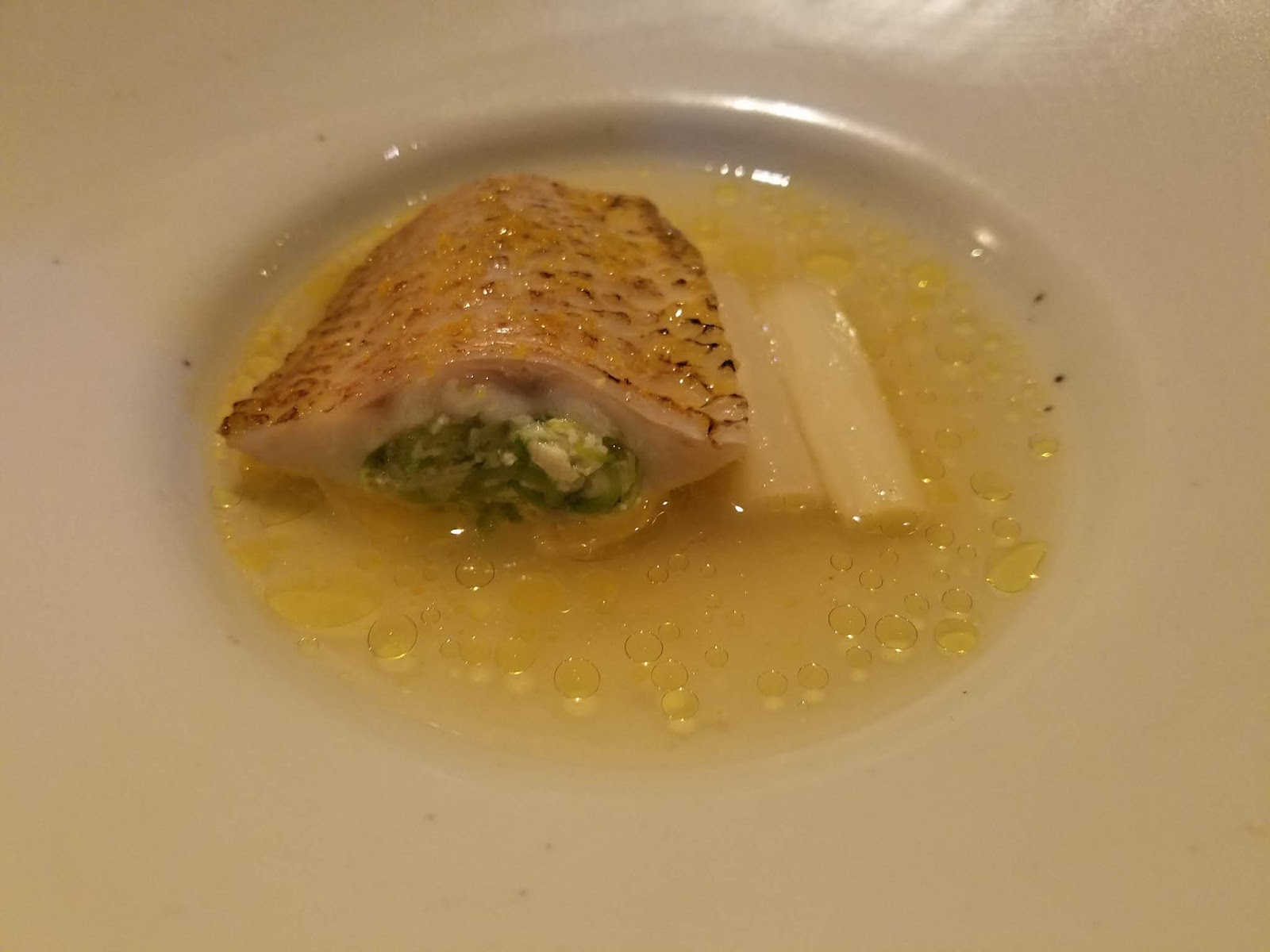
Another great dish, the fish was flavorful and stuffed with (I believe) zucchini and shrimp. To the right is white asparagus and based on the taste, I think the broth is clam or oyster based (although probably has some fish in there too).
8) Jang Noodle - squid ink & seaweed jang sauce, seasonal sea food and mingle's style pasta

This was our second extra course of the night, so we shared this semi-large dish.
This was delicious, probably my favorite of the night. These noodles were delicious, with good texture, and far better than the typical trash squid ink noodles I've eaten. The seaweed jang added some good umami flavor. On top is lobster and uni. The lobster was amazingly tender, I'm not sure what they did to manipulate the lobster to give it that tenderness of if its some variant lobster breed in Korea.
9) Egg Custard

This is apparently a signature dish from the restaurant. I missed the details the staff said when describing the dish. I picked up truffle while eating it. Online, various ingredients are listed, it might be the case that this dish is altered depending on the season. There were some crunch bits at the bottom, that might have been chorizo.
I was a little surprised when I dug into the egg, as the white above is mostly foam. I was expecting something "thicker", so I think I messed up and didn't quite collect all of the flavors at the same time. Some good flavor here, but the foam sort of threw me off.
10A) Lobster - Organic Vegetables from Junhyuk's Farm, egg yolk-doenjang sauce

So I missed a lot of the details the staff said when they brought out the dish, so I'm not sure what the sauce in the middle was. But going off the menu, it's a combo of egg yolk with doenjang, a fermented bean paste. Regardless, it was tasty. The lobster was tender and not as chewy as I'm normally used to, although had more chew than the lobster in the jang noodles above. Unsure if that's due to the cooking technique or a different lobster type. Either way, very good. Off to the upper left is a whole bunch of squash, tomato, and something I'm unsure of. It looks like leek, but had a starchy texture. Perhaps some potato or yam that was put into a swirl.
10B) Korean Beef - Charcoal grilled 1++Striploin with soy sauce

My +1 got the steak and of the few pieces I tasted, it was absolutely amazing. I don't know what cow this came from, it wasn't wagyu / kobe, but it was incredible. The sauce was made with soy sauce, citrus, and truffle, although I don't know what the white stuff in the middle is. There's also some potato and carrot.
11) Vegetable - Cold soy bean soup, seaweed noodle & tomato tart


Next up we had a (I think) traditional soy bean soup that had seaweed noodles and some other vegetables in it (I recall cucumber and a lima-bean-ish bean). I tried cold soy bean soup for the first time during my trip to Korea, and this was probably the second time I ever had it in my life, so it's a little hard to judge. It tasted fine I guess.
The tomato tart apparently had tofu in it as well, but we couldn't quite pick it up. We were wondering if it was not what we thought of tofu, but some alternate soy product. Overall, pretty good.
13) Fruit / Palatte Cleanser

This was brought out as (what I assume) was a palate cleanser of sorts before dessert. It's a cherry and what I believe is called "mountain strawberry", although it looks more like a raspberry.
14A) Jang Trio - Doen-Jang creme brulee, gan-jang pecan, gochu-jang blackrice, vanilla ice cream, whisky foam

So I had to look a lot of this stuff up, doenjang is a soybean paste, ganjang is soy sauce, and gochujang is red chili paste. I guess the ganjang was used to marinated the pecans and the gochujang was used to flavor the rice above. Included on top were also the ice cream and whisky foam.
While I have little knowledge of "jang", I loved this dessert. All the different textures and flavors mixed together were wonderful, the ice cream being thick, the whisky foam being foamy, the crunch of the brulee at the bottom, and all the rice and pecan textures. Just delicious, it'll definitely crack my top ten desserts of all time.
14B) Summer Citrus - hallabong (jeju orange) sorbet, mango, orange, lemon basil compote, creme anglaise

So I can't comment on this dish because I didn't try it b/c of my tropical fruit allergy. My +1 said she loved this dessert. She said the sorbet was more foam-ish than sorbet-ish.
15) Sweets

Finally the mignardise. Some cookies at the top, some type of root flavored jelly at the left (Korean ingredient I'm not familiar with), and some sesame cookies on the right. They also served us tea as part of the meal, which I won't bother to post a picture of.
Overall, this meal was wonderful and I can understand why it's ranked so highly. This reminded me a lot of my meals at Benu and VEA, a French / Western styled meal with strong Asian influence, in this case specifically Korean influences.
Unlike those other meals, I was not as familiar with Korean food or Korean ingredients and did not get as much emotionally out of this meal. Minimally I didn't know a number of ingredients, and without the Korean cuisine knowledge base, it's hard to know where some of the dishes/ingredients/reinterpretations are coming from (e.g. the fish mandu or the soy bean soup). If you read the details in my pictures, you can tell I missed a lot. Perhaps the next time I visit Seoul, I'll be more prepared and can appreciate the cuisine far more.
It's worth noting the price of the meal as well. In USD, this meal would be a little under $300 for two people if no extras and no drinks were ordered. That's a pretty good price given this restaurant's reputation. Even with the additional supplements we paid (two extra shared courses, lobster supplement, beef supplement), the price still came to about $335 USD without drinks.
Subscribe to:
Posts (Atom)